

UX STRATEGY • UX RESEARCH • PRODUCT DESIGN • MOBILE APP
Vanish AI
A private AI chat app
from 0 to 1
Project Scope
• UX Strategy
• UX Research
• UX/UI Design (Desktop/ Mobile)
Tools
Figma • Tableau • Chat GPT • Perplexity • Gemini
Deliverables
Competitive Benchmarking Report • In-house UX survey and design • User personas • User flow • iOS and Android app design • Subscription/ paywall UX
Overview
Startpage serves over 1 million daily users with private search, delivering Google-quality results without storing personal data, IP addresses, or search history. As AI began reshaping how people find information, Startpage faced a strategic gap: every major competitor had already integrated AI into their product. Startpage had none.
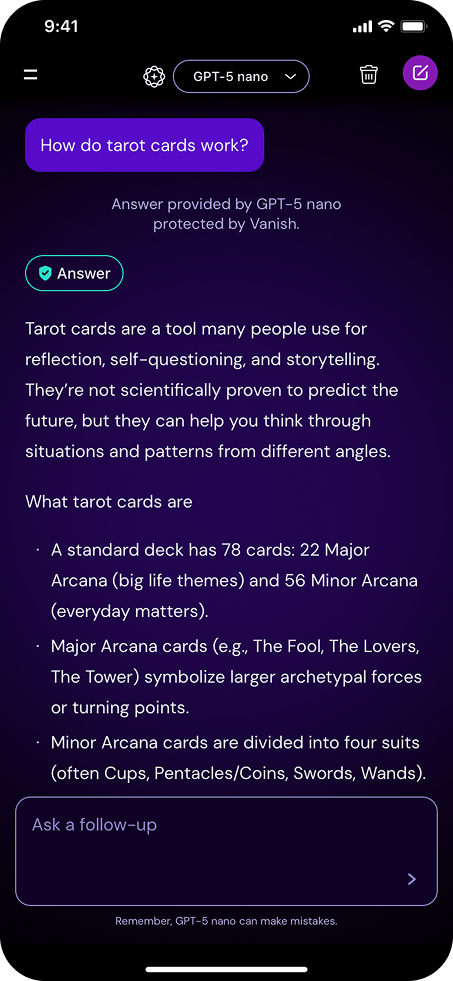
Vanish is a private AI chat app that gives users access to leading large language models inside a privacy wrapper. No data training, no tracking, no profile building. As Senior UX Designer, I led the research strategy, designed the complete user flow from onboarding to subscription management, and collaborated with our UI designer on the final product experience.
Solution
Vanish offers a freemium private AI chat experience with a clear value ladder: up to 10 free conversations daily, with a Pro subscription unlocking unlimited chats, access to advanced LLMs, and image generation. Originally launched as a standalone product in summer 2025, Vanish was rebranded and relaunched under the Startpage umbrella in December 2025 — reaching 6,000 installs and a 4.8-star App Store rating.
Research
The Challenge
AI is actively reshaping how people find information. Competitive benchmarking showed that all of Startpage's direct competitors (Brave, DuckDuckGo, Ecosia, Kagi, Qwant) had already integrated AI features. Startpage was the only holdout.
But Startpage's users are not a typical audience. They chose this search engine specifically because it doesn't use their data. Integrating AI carelessly as a forced SERP feature, without user control risked alienating the very users Startpage had earned. The challenge was to move quickly enough to stay competitive while building something this privacy-conscious audience could actually trust.
Validating Feasibility
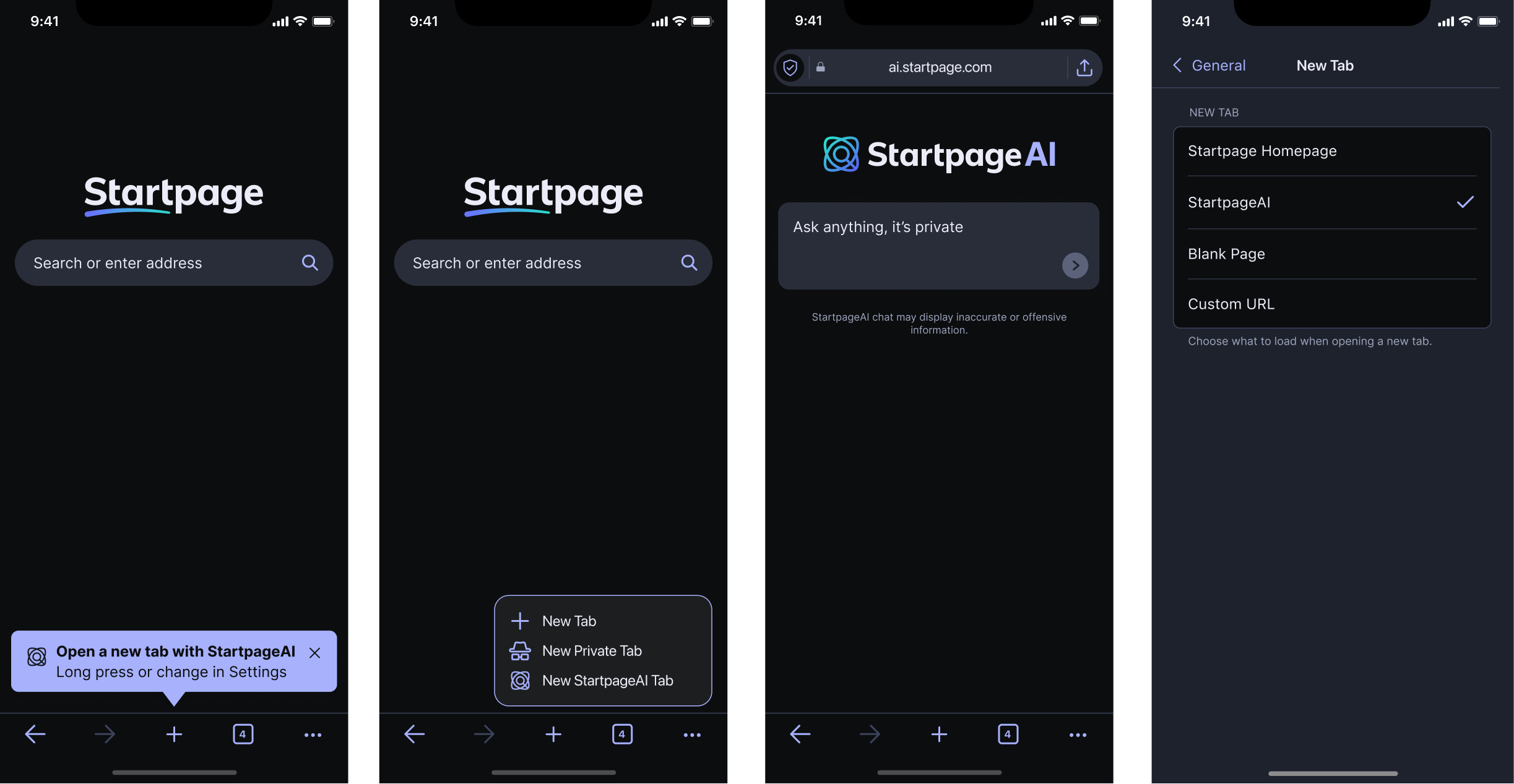
Before committing to a standalone product, the team ran a proof of concept: PrivateAI, a browser-integrated AI feature inside Startpage's iOS mobile app, built in roughly three months. It validated that we could ship AI quickly within our technical ecosystem and gave us a foundation to build on.
Competitive Benchmarking
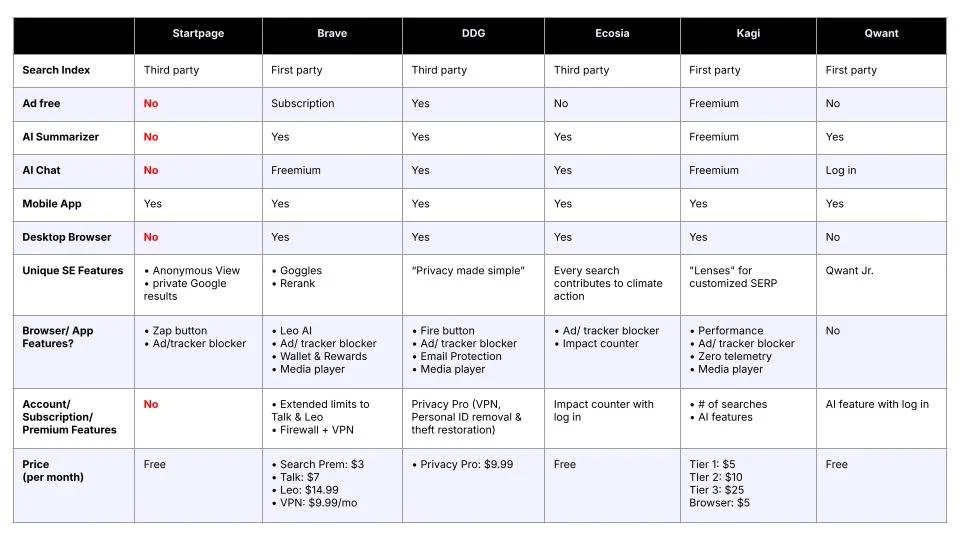
A structured audit across private search engines and AI chat platforms revealed the scale of the gap. Every direct competitor offered AI, from AI summarizers and instant answers to full LLM-powered chat with model selection, source citation, and dedicated subscription tiers. Startpage's mobile ratings were competitive (4.8 iOS), but download volume was a fraction of Brave's or DuckDuckGo's. While the download gap is likely influenced by competitors' larger marketing budgets, the lack of AI parity and product breadth wasn't helping and closing that gap was within our control.
In-House User Survey
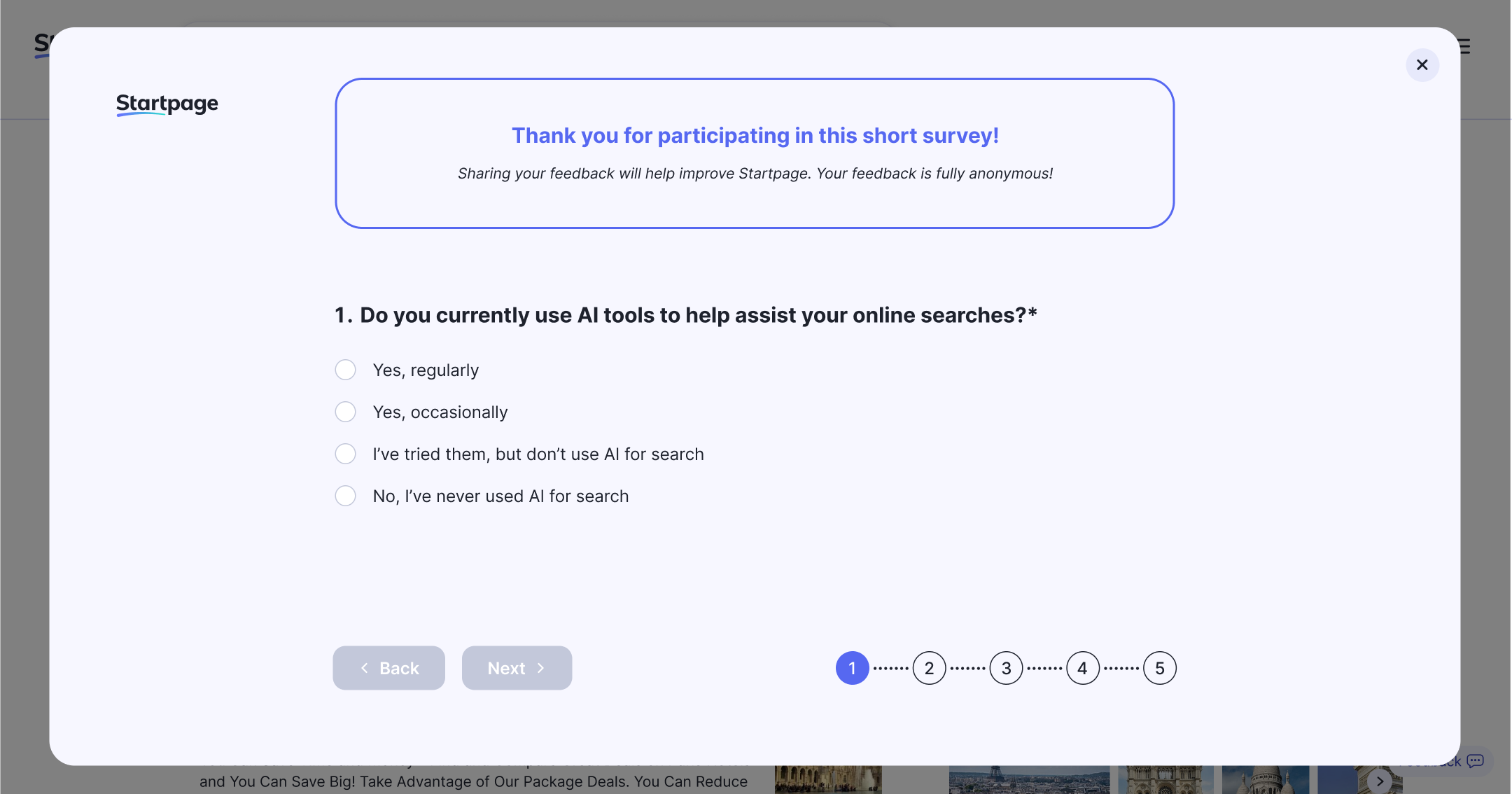
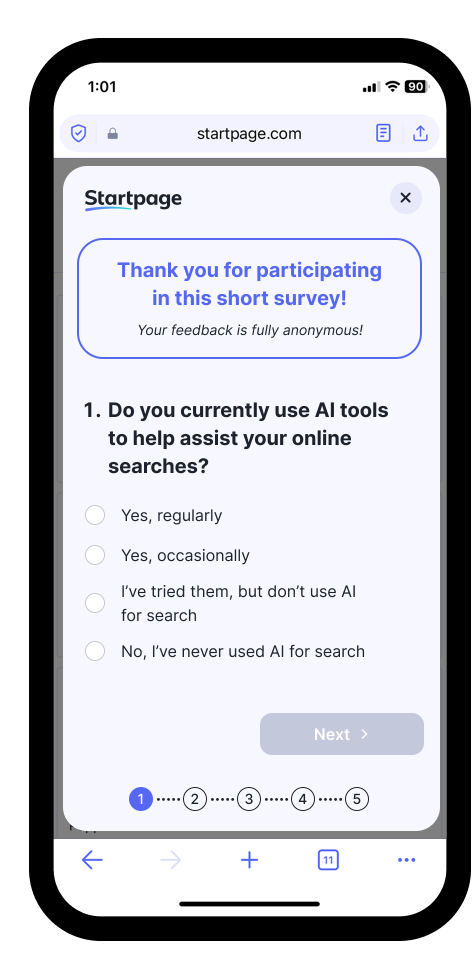
Two core questions drove the survey: How and when do we incorporate AI into Startpage? Should we offer a subscription? I designed the 6-question in-product survey, deployed across Startpage's desktop and mobile traffic in 3 languages over one week. We targeted 10,000 responses for statistical significance. We received 24,700+.
After using Gemini to help classify the responses, the results surfaced four distinct user segments.
Personas
The Purists
~35%Against AI on Startpage for a range of reasons. 2% explicitly threatened to leave if AI was introduced.
The Concerned Middle: Forward Looking
~30%Mixed on AI; may find other product improvements more pressing than AI.
The Concerned Middle: Status Quo
~10%Mixed on AI, love Startpage as it is. Resistant to any change.
~25%The AI Optimists
Excited to try AI features with the caveat of privacy. Many already pay for other AI tools.
The quantitative findings sharpened the business case. Ignoring the ~32% of users open to AI represented an estimated ~$8M/year opportunity cost. Forcing AI onto resistant users risked only ~$667K/year in churn. The math pointed in one direction — but how we introduced AI would make all the difference.
Design Solution
User Flow
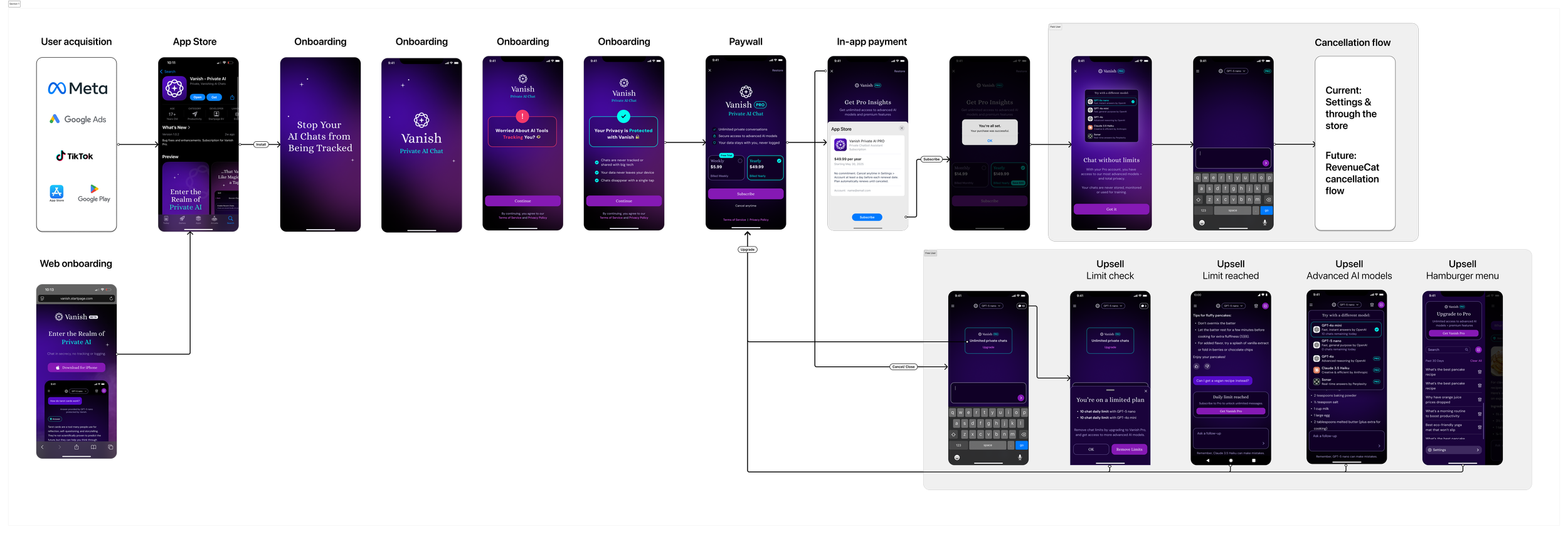
I designed the full user journey — from first open through onboarding, chat interface, model selection, freemium limit states, paywall, Pro subscription, and cancellation. The survey's clearest mandate — opt-in, privacy-first, uncluttered — shaped every decision in the flow. Privacy messaging is introduced during onboarding, not buried in settings, making clear that Vanish operates under the same no-tracking commitment as Startpage. The tone treats users as people who've already made a considered choice about privacy, not an audience that needs convincing.
LLM Selector
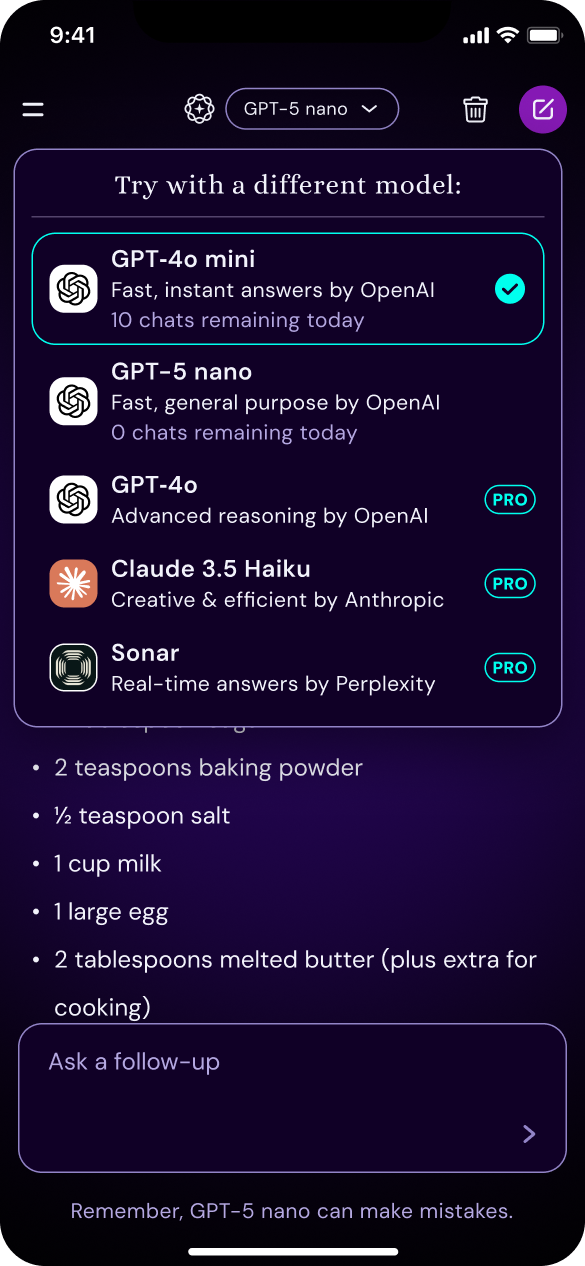
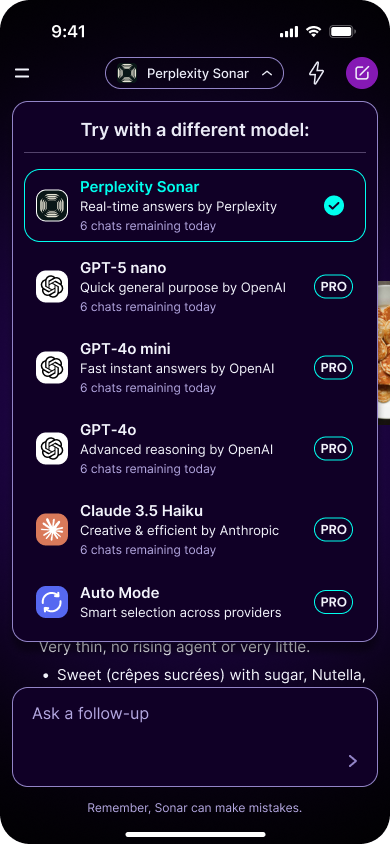
Giving users choice between ChatGPT, Claude, and Perplexity is central to Vanish's value proposition — but model selection can easily become friction if handled poorly. The selector was designed as a persistent, accessible control within the chat interface so users can switch contextually based on their task. For free-tier users, all models are visible but advanced ones are clearly gated behind Pro — giving full visibility into what upgrading unlocks, surfaced before the limit state rather than at it.
The Paywall
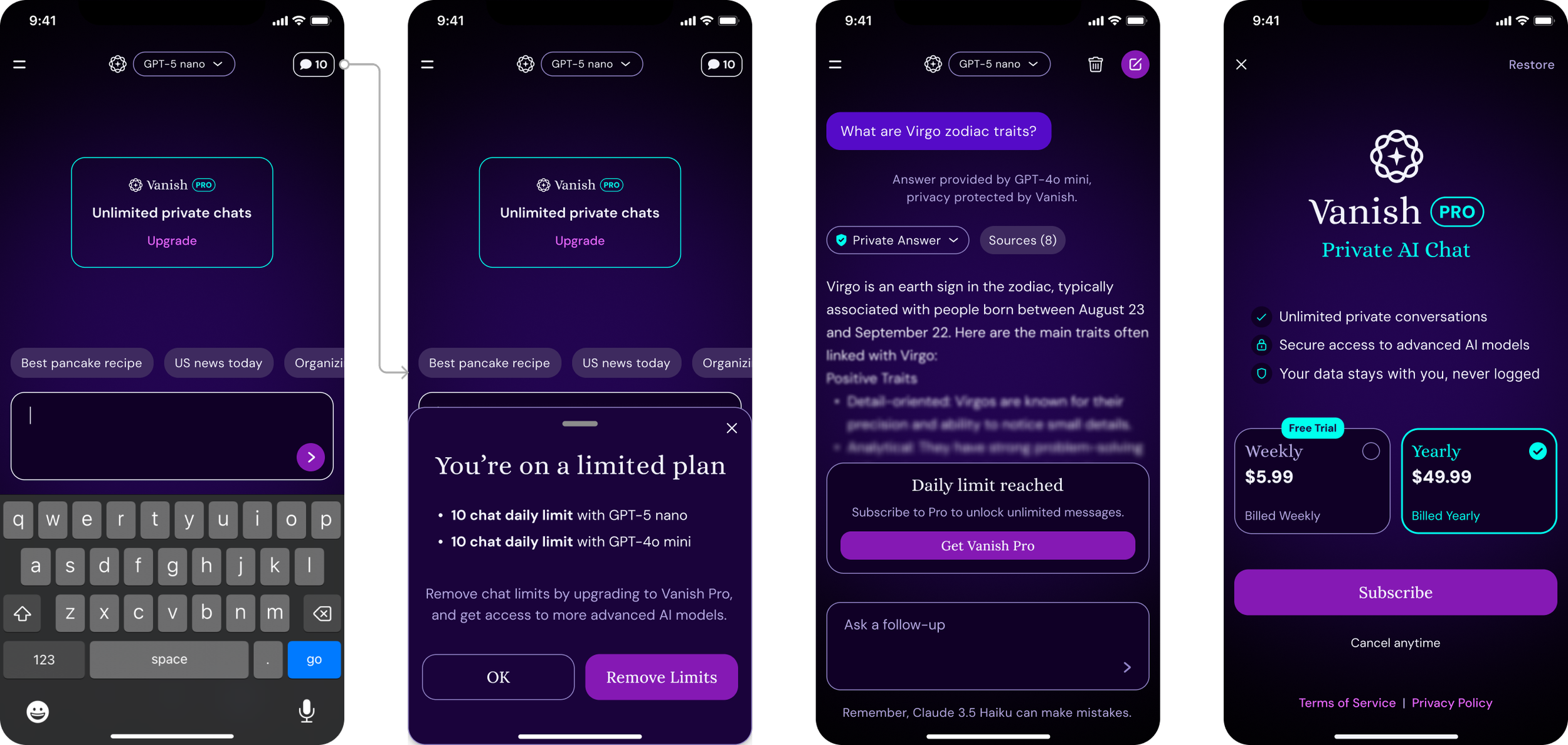
For an audience already skeptical of anything that feels like it monetizes their behavior, how the paywall gets introduced matters. The freemium limit state — 6 chats per day — was designed to feel informational rather than punitive: a visible count, a prompt to upgrade that leads with value (unlimited chats, advanced LLMs, image generation) rather than urgency. The trial CTA was deliberately low-commitment: try Pro, experience the difference, then decide.
The Rebrand Moment

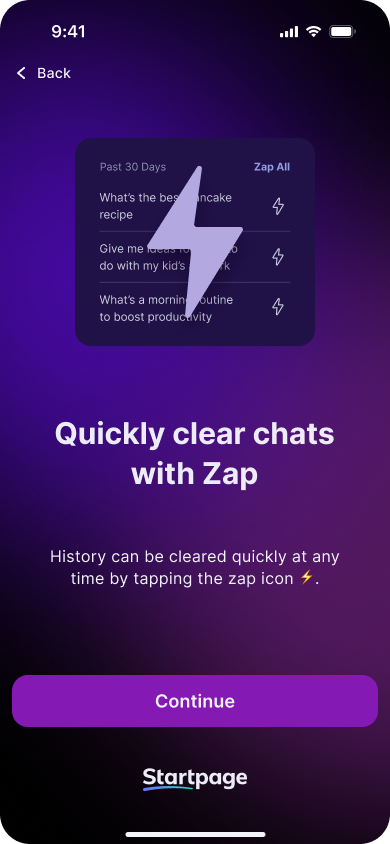
After the standalone Vanish app launched in summer 2025, it became clear that acquiring new users for an unknown standalone product was expensive and slow. The strategic pivot was to relaunch under the Startpage brand — leveraging 1M+ daily organic users as a built-in distribution channel, and aligning directly with the survey's recommendation to market the AI app to Startpage's existing user base. The rebrand was executed in 2–3 weeks: copy and in-app messaging were updated to align with Startpage's brand voice and privacy positioning throughout the flow; the UI designer handled the visual adjustments. The core UX structure remained intact.
Outcomes
At 10% US traffic rollout, the Vanish promo was appearing in approximately 60,000 daily sessions. The app achieved a ~42% click-to-install rate — above the ~34% App Store average — and a 12% install-to-trial conversion, roughly 4x the freemium industry benchmark of 2.6%. For a brand-new product at limited rollout with no standalone marketing budget, these numbers signal strong product-market fit at an early stage. The app continues to hold a 4.8-star iOS and 4.3-star Android rating as of early 2026.
~42%
(vs. ~34% App Store average)
Click-to-install rate
~12%
Install-to-trial conversion
(vs. ~4x freemium industry benchmark)
4.8 ★
iOS App Store rating
4.3 ★
Android Google Play rating
Reflection
Vanish is proof that a small focused team can take a product from zero to market in three months and that research can do more than inform design; it can de-risk a business decision and provide the evidence to act. The survey didn't just tell us what users wanted. It quantified the cost of getting it wrong in either direction, and pointed to exactly the product we'd already built.
The harder lesson was alignment. When strategic direction shifts mid-build, design and engineering absorb that cost in double work and compressed timelines. We adapted fast — but the ideal would have been not needing to.
The next feature set is already defined: file uploads, local LLM options, multi-modal inputs, deeper user controls. The foundation is solid and the demand signal is there. This app is ready for its next chapter.